
Thought leadership
Why training is now critical to winning investment
Professional development is emerging as a key competitive advantage in investment promotion. Success increasingly depends on teams that can understand investor needs, communicate value clearly and respond to rapidly changing market conditions. Organisations that invest in capability-building are better positioned to attract investment, strengthen performance and compete long term.
- May 28, 2026
-
By Shirar O’Connor-Mugler
Why training is the real competitive advantage in investment promotion
In today’s global economy, investment promotion and economic development organisations must answer two defining questions for businesses considering expansion or relocation: why here, and why now?
Modern economic development is no longer about simply marketing a location. Investors expect evidence-based answers supported by workforce data, infrastructure readiness, sector intelligence, supply chain access, and long-term growth potential. Economic developers must connect a company’s operational needs to a community’s competitive advantages in ways that are strategic, timely, and commercially relevant.
Delivering that level of sophistication depends on one critical factor: people.
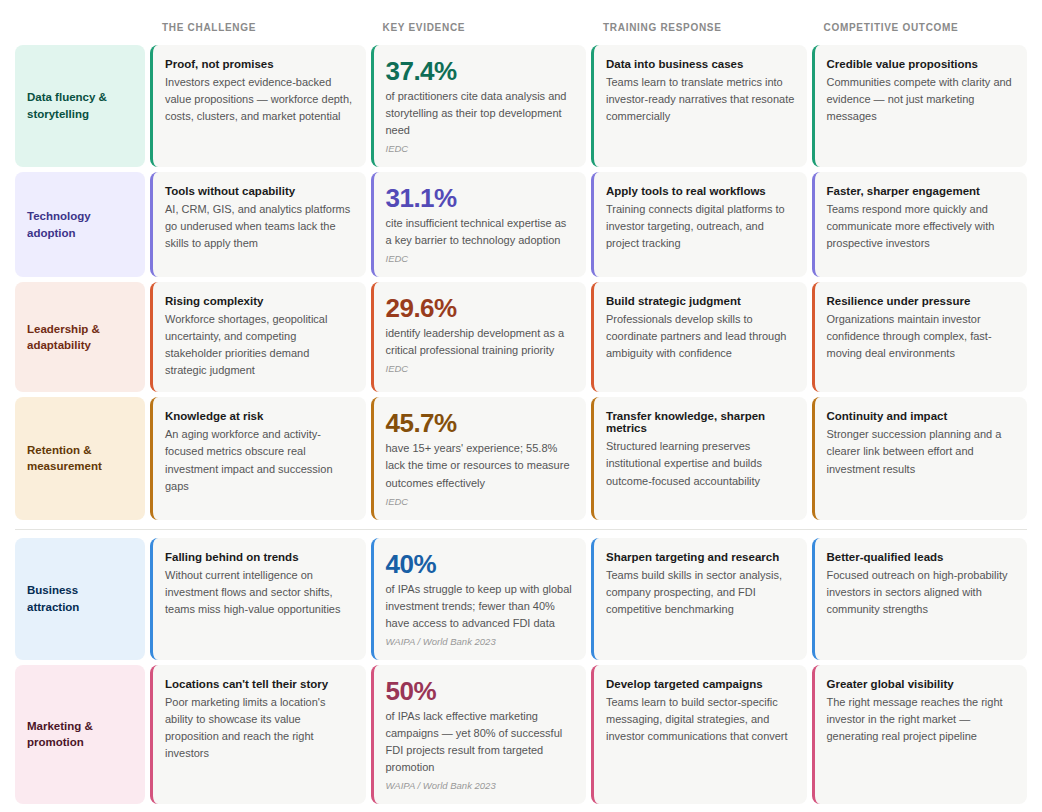
Investment attraction capability can be understood across various learning pillars. The following framework provides an illustrative example where organisations often struggle, what the evidence suggests, and how targeted training can translate capability gaps into stronger investor engagement and better project outcomes.
Training as a competitive advantage in investment promotion
Professional development is a strategic necessity
Economic development is fundamentally a people-driven profession. While strategy, incentives, and infrastructure matter, outcomes ultimately depend on the professionals responsible for engaging investors, guiding due diligence, solving problems, and building long-term relationships with companies.
Research from the 2025 State of the Field Report by International Economic Development Council (IEDC) highlights how strongly the profession already values learning and development:
- Economic development practitioners participate in an average of 4.48 professional development activities annually
- 85.2% attend conferences or industry events
- Only 54.9% participate in formal training or certification programmes
These findings suggest that while the industry values learning, there is significant opportunity to make professional development more strategic and directly tied to investment attraction and overall organisational performance.
Training should not simply expose staff to information. It should strengthen organisational capabilities across:
- Investor engagement
- Business attraction
- Strategic communication
- Research and analytics
- Deal facilitation
- Investor servicing
Data fluency and storytelling have become core skills
The profession itself recognizes that the required skill set is evolving rapidly. According to the report:
- 37.4% of practitioners identified data analysis and economic storytelling as a top development need
- 32.2% identified digital tools and innovation, including AI, as areas to improve
- 29.6% identified leadership development
These figures reflect a major shift in investment promotion. Investors increasingly expect communities to support claims with credible, actionable evidence. Workforce availability, logistics access, sector clusters, infrastructure, and market intelligence must all be communicated clearly and persuasively.
However, data alone is insufficient. Communities must translate complex information into compelling narratives that explain not only why a company should invest today, but why it can succeed in that community over the next 20–30 years.
Research from the World Bank and the World Association of Investment Promotion Agencies (WAIPA) similarly emphasizes that institutional capability, responsiveness, and strategic communication are now central drivers of successful investment promotion.
Technology adoption is a capability challenge
Technology is transforming economic development operations. AI tools, CRM systems, GIS platforms, analytics dashboards, and automation software are increasingly essential for today’s business attraction effort, yet many organisations struggle to integrate these tools effectively.
According to the 2025 State of the Field Report by IEDC:
- 64.8% cite funding limitations as a barrier to technology adoption
- 52.5% cite lack of time
- 31.1% cite insufficient technical expertise
These findings reinforce an important reality: technology adoption is not simply a procurement issue , it is a workforce capability and training issue.
Organisations do not become more competitive because they purchase software. Competitive advantage comes from teams that know how to use technology to:
- Improve investor targeting
- Accelerate research
- Enhance responsiveness
- Support strategic decision-making
- Communicate more effectively with investors
Training ensures organisations maximise the value of the tools they already possess while avoiding the common mistake of investing in technology without investing in staff readiness.
Leadership and adaptability matter more than ever
Economic development professionals are also operating in an increasingly complex environment shaped by:
- Workforce shortages
- Supply chain restructuring
- Housing pressures
- Infrastructure demands
- Geopolitical uncertainty
- Rapidly changing investor expectations
As a result, economic developers must do far more than market communities. They must lead through uncertainty, align stakeholders, manage organisational change, and maintain confidence across both public and private sectors.
This growing complexity explains why nearly one-third of respondents in IEDC's research identified leadership development as a critical training need.
A profession in transition
The economic development profession itself recognizes it is undergoing major change. The IEDC state of the field report shows:
- 46.3% of respondents say the field is stable but facing emerging challenges
- 28.2% say the profession is actively in transition
- At the same time, 82.8% of practitioners identify business attraction as their primary focus area.
This makes professional development directly tied to investment attraction outcomes more important than ever. Organisations increasingly need teams capable of:
- Conducting sector and company research
- Developing strong value propositions
- Executing investor outreach strategies
- Managing relationships
- Supporting aftercare and expansion projects
- Facilitating deals efficiently and professionally
In a marketplace where investors expect speed, sophistication, and strategic insight, outdated approaches create competitive disadvantages.
Retention, continuity, and organisational resilience
The profession is also facing a significant demographic challenge with the report showing:
- 45.7% of practitioners have more than 15 years of experience
- Only 10.3% have 0–2 years of experience
This imbalance creates risks around institutional knowledge transfer, succession planning, and long-term organisational continuity. Without intentional investment in mentorship and training, organisations risk losing critical expertise and investor relationships as experienced professionals retire or transition out of leadership positions.
Turnover in economic development can weaken investor confidence, slow execution, and reduce organisational effectiveness. A strong culture of continuous learning helps preserve expertise while preparing the next generation of leaders.
Measuring what matters
Another challenge identified by IEDC is performance measurement:
- 55.8% of respondents cite insufficient time, staffing, or budget as barriers to measuring performance effectively
Many organisations still focus heavily on tracking activity such as meetings, outreach efforts, or events, rather than measuring strategic outcomes such as competitiveness, investment generation, job creation, and long-term economic impact.
Effective training can help organisations:
- Prioritize high-value activities
- Improve accountability
- Strengthen strategic decision-making
- Connect effort to measurable economic outcomes
The goal is not simply to measure more activity, but to measure what truly drives investment success.
The real competitive advantage
In a global competition for capital, talent, and jobs, the ultimate differentiator is not incentives, branding, or infrastructure alone, it is also organisational capability. Is your organisation high-functioning? Do you deliver on what you promise? Can the company see your organisation as an asset as they navigate your community?
The most successful investment promotion organisations invest in their people. They build teams that communicate clearly, adapt quickly, solve problems collaboratively and guide investors through complex decisions.
Professional development belongs at the centre of an economic competitiveness strategy. It strengthens the people responsible for turning a community’s assets into investment opportunities.
fDi Institute provided an enviable opportunity to access an in-depth knowledge about the global investment climate which is relevant and critical not only to attracting sustainable investment but to my career advancement as an investment officer. The research findings are on point and very factual. This is just what IPAs need to stay on top in their quest to attract the right FDI.Joan Shaw, George Municipality (WESGRO)
Build your FDI expertise
Build capability across your organisation with fDi Institute through self paced e-learning courses and bespoke workshops designed for investment promotion and economic development professionals.
Get in touch to learn how fDi Institute can support your team’s development or request a demo to get an in-depth overview of the product in action.
Further reading
IEDC: 2025 State of the Field: General Report
Read blog: FDI in flux: Lessons from the fDi Institute Live Workshop
Read blog: Why intelligent investment promotion still starts with humans
Learn more about FT Locations
FT Locations is the world's most comprehensive and trusted provider of investment promotion and economic development data and digital solutions for the foreign and domestic direct investment industry.

