
Market deep dives
Brazil between blocs: Do economic alliances drive investment?
As global investment patterns shift, Brazil is emerging as a key link between the BRICS and G7 economies. A record surge in BRICS investment has transformed the country’s FDI landscape, challenging the G7’s long-standing dominance while raising important questions about the country's reliance on China and the US as major sources of foreign capital.
- June 24, 2026
-
By Alfie Williams-Hughes
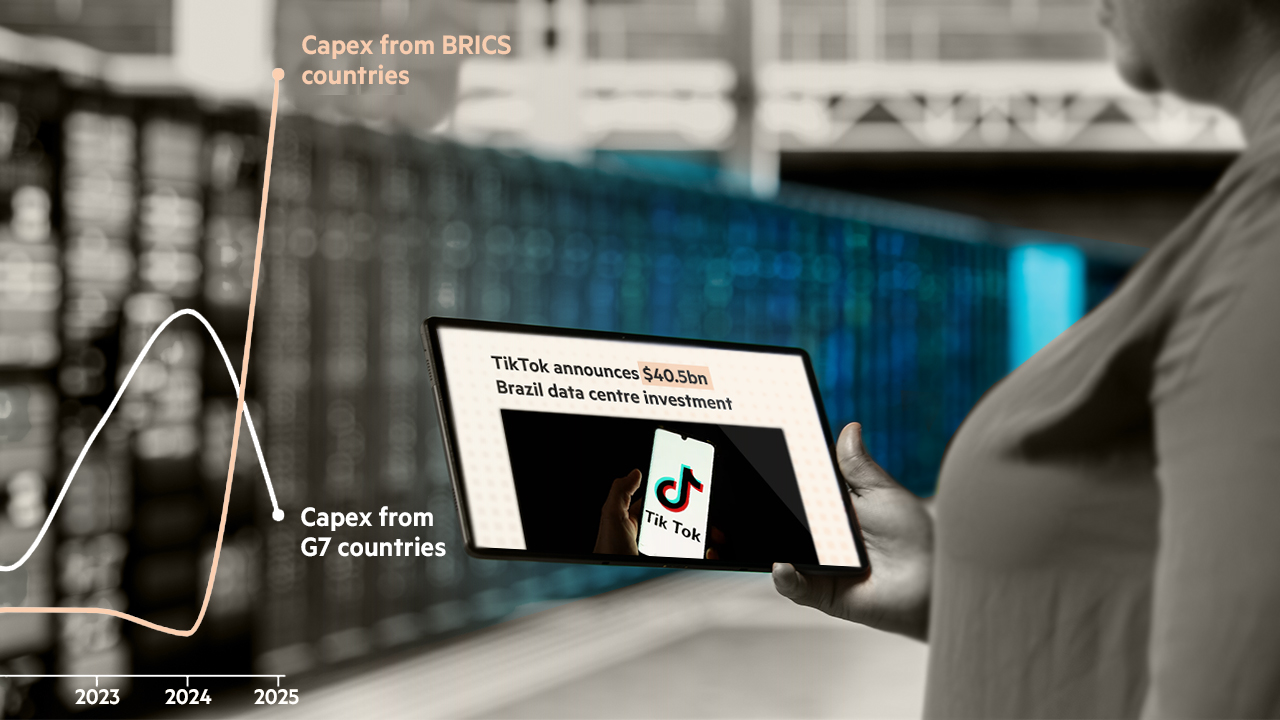
Instability in the Middle East, tariff onslaughts, and diplomatic fragmentation; geopolitical and economic alliances are being tested on the global FDI stage. Since becoming a founding-member of BRICS in 2009, Brazil has strengthened its economic and geopolitical development thanks to other members within the bloc, and yet it heavily relies on investment from countries outside of the BRICS alliance, notably the G7 countries. What has defined FDI into Brazil over the past decade is the balance the country has struck between attracting investment from the Global North and from the Global South. However, in 2025, for the first time on record, FDI capital expenditure into Brazil from BRICS countries, not including Brazil, overtook investments from the G7 bloc.
The investment picture
Since 2016, FDI into Brazil from BRICS(1) and G7(2) countries has followed a similar ebb and flow pattern. For instance, in 2019, investment flows into Brazil from both BRICS and G7 hit highs of $3.9bn and $15.5bn, respectively; these figures sharply fell in 2020 as the world was plunged into an economic slowdown due to the Covid-19 pandemic.
Although investment from BRICS countries was quicker to recover after the shock of the pandemic, capital expenditure flowing into Brazil remained relatively stagnant until 2024. It is also worth noting that G7 investment has dominated that of BRICS, representing 41.1% of all FDI flowing into Brazil from 2016 to 2025. In contrast, BRICS capex into the country stood at 20.5% of total FDI throughout the same period. Although the G7’s share of total FDI into Brazil, during the period, is slightly lower than its global FDI share of 46.5%, BRICS capex into Brazil exceeds its global FDI share of 15.4%.
One factor contributing to Brazil’s success in attracting FDI from both blocs is the dynamism of sectors in which companies have chosen to invest. Brazil has historically relied on traditional sectors such as oil and gas, agriculture, and manufacturing, but, in recent years, it has moved towards sunrise industries like communications, renewable energy, and fintech.
Deviations from the norm
G7, drastically thwarting the investment dynamics between the two blocs. Firstly, investment from the G7 fell from $26.6bn in 2024 to $11.7bn in 2025, the lowest level since 2022. Conversely, BRICS investment into Brazil surged upwards from $3bn in 2024 to $43.8bn in 2025, thanks to a $40.6bn data centre announcement from TikTok, a subsidiary of China-based ByteDance, into the state of Ceará.
The mega investment comes at a time when mature economies, like the US, are redirecting their investments towards the domestic market , whilst the main BRICS players, such as China, are seeking to expand their influence far overseas. In particular, what makes Brazil attractive to its BRICS partner is its strategic location, wedged into Latin America, still in short proximity to North America. Additionally, for China, a leader in telecommunications, Brazil is experiencing a growing demand for network infrastructure, with an estimated 95% of people using the internet on a daily basis, up from 60% in 2016. Finally, Brazil boasts a strong pool of tech talent, with a large concentration of skilled software developers.
Dependency on the few
In 2025 alone, TikTok’s $40.6bn investment into Brazil trumped the $11.6bn investments originating from all the G7. When investments from each source in the blocs are compared, during the period 2016 to 2025, two countries dominate: China and the US. Among the BRICS countries, over the past decade, Chinese investment has represented 91.3% of total BRICS investment, which demonstrates a strong dependency on China. Similarly, the US is the key source market within the G7, accounting for 43.9% of total FDI into the country from 2016 to 2025 from the G7 bloc.
Despite current global economic and geopolitical tensions, Brazil has maintained relatively stable relations with most Western countries, whilst also fortifying its partnerships with member states from BRICS. The country boasts promising renewable energy, technology, and communications sectors, whilst it remains competitive in its historically successful sectors like oil and gas, and agriculture. Economic alliances such as the G7 and BRICS play an important role in Brazil’s FDI inflows; however, with the vast majority of investment coming from just two countries, Brazil will have to work hard, like any other country, to repeat the same scale of mega investments in the coming years.
Dictionary
(1)‘BRICS’ countries investing in Brazil: Russia, India, China, South Africa, Egypt, Ethiopia, Iran, the United Arab Emirates, and Indonesia
(2)‘G7’ countries investing in Brazil: France, Germany, Italy, the UK, Japan, the US, and Canada.
Further reading
Statista: number-of-internet-users-per-100-inhabitants-in-brazil-since-2000
UNCTAD: Two decades of intra-BRICS trade: Trends, patterns and policies
Morgan Stanley: Brazil: Rewiring the Economy
BCG: A Changing World Order Is a Historic Opportunity for Brazil
The Diplomat: How China Is Using Brazil to Reshape Power in the Americas
Site Selection: BRAZIL: Brazil’s Handshake To the World
Read blog: Redirection, not retreat: Tariffs and North American FDI
Read blog: Energy transition hit by fossil fuel investment surge
Read blog: Why training is now critical to winning investment
Learn more about FT Locations
FT Locations is the world's most comprehensive and trusted provider of investment promotion and economic development data and digital solutions for the foreign and domestic direct investment industry.

