
Event learnings and takeaways
Webinar recap: Securing Semiconductor FDI
FDI expert Glenn Barklie, Head of Economic Analysis and Insights at FT Locations, summarises the key insights from the webinar, exploring global semiconductor FDI trends, investment patterns across the value chain, the location factors shaping investment decisions, and the strategic implications for investment promotion agencies and economic development organisations.
- July 02, 2026
-
By Glenn Barklie
Securing Semiconductor FDI: Key Trends and Strategic Implications
Semiconductor FDI is on the rise. In our recent webinar, we unpacked the current trends and examined the strategic implications for investment promotion agencies (IPAs) and economic development organisations, as well as answering several intriguing questions posed by attendees.
A sector experiencing unprecedented investment growth
Semiconductor FDI has grown substantially. In 2025, greenfield investment reached record levels, with 156 projects being announced, worth an estimated $138bn. There has been a notable jump in activity since 2021. The increase is due, in part, to significant and sustained demand for AI and data centres. However, several other industries, from automotive to energy, are also becoming increasingly reliant on chips. The increase in demand, which will soon see semiconductors become a trillion dollar industry (by revenue), should also translate into sustained FDI.
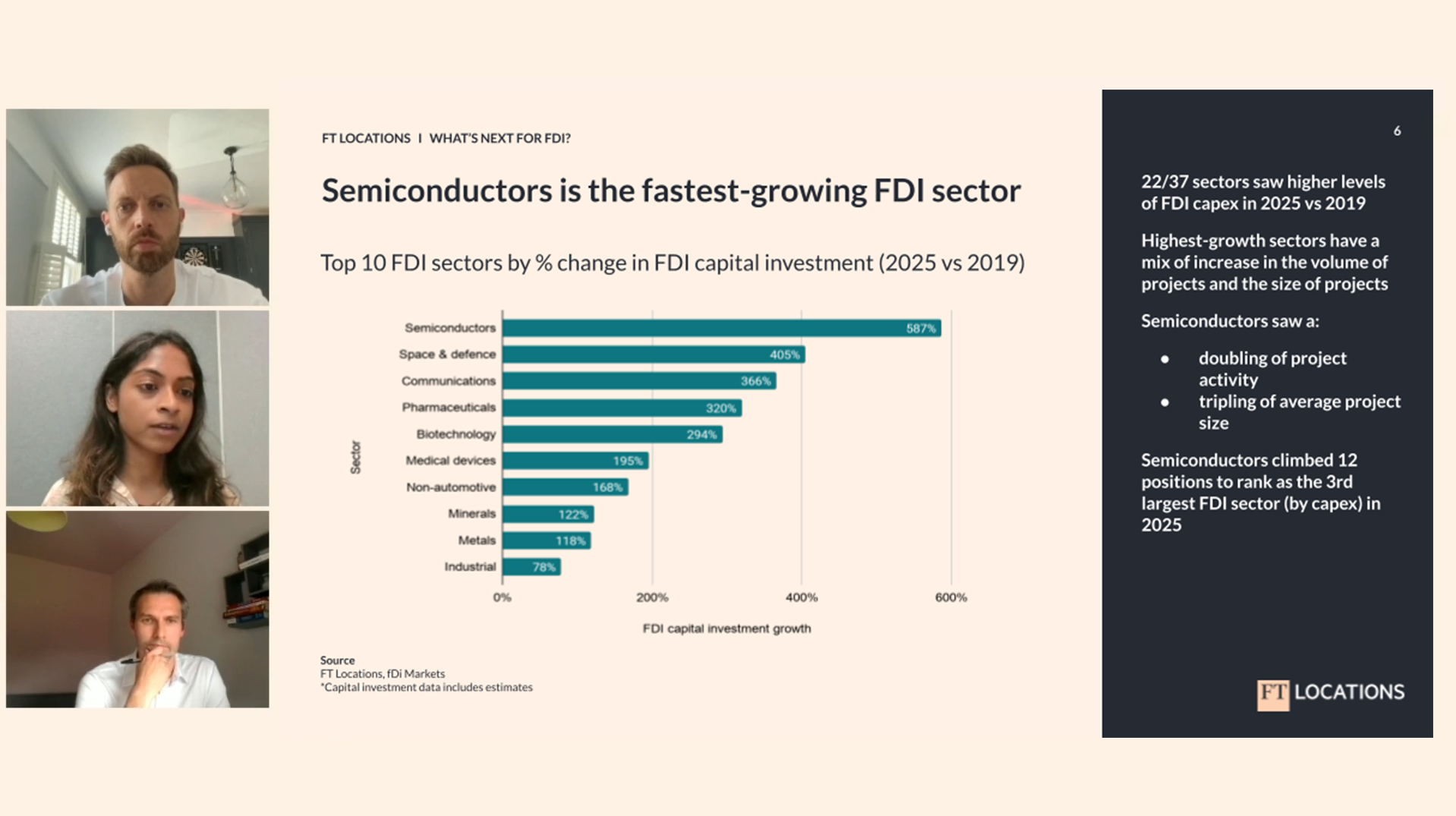
To put the growth in semiconductor FDI into context, between 2019 and 2025 it has been the fastest growing of any sector. When comparing FDI capital investment in 2025 with capex in 2019, investment levels were 587% higher. This growth is due to a doubling in the number of FDI projects and a tripling in the average size of projects. Semiconductors climbed 12 positions – the greatest change of any sector between the two periods – to rank as the third largest FDI sector, behind only communications (driven by data centre investments) and renewable energy.
High-value investments with significant economic impact
Semiconductor projects are distinguished by their high concentration in manufacturing and research and development (R&D) activities. The sector is the most manufacturing/R&D intensive of any FDI sector in terms of FDI capital investment and job creation. It also ranks high (3rd out of 37 sectors) in terms of the intensity of project activity.
For investment promotion agencies, this makes semiconductor projects particularly attractive as capital investment and job creation are typically high. Additionally, fabrication facilities, advanced packaging operations, design centres and R&D facilities generate skilled employment, technology transfer, export opportunities and long-term ecosystem development that extend well beyond the initial investment.
Projects becoming more global, but capex is concentrated
More detailed analysis revealed some further interesting trends in semiconductor FDI. In 2025, project activity spanned 40 countries - the highest it has ever been. But when looking at the spread of activity and capital investment using a Shannon Index, we found that the industry acts like activity is evenly dispersed across 23 countries while capital is heavily concentrated in just three. FDI capital investment is more concentrated in the semiconductor sector than any other FDI sector. So, while project activity has become more global, capital investment is still highly concentrated.
Geography matters
The US and countries in Southeast Asia and East Asia dominate semiconductor FDI. Asia-Pacific accounted for 47% of FDI project activity between 2021 and 2025, while the US was the leading destination country. Other top destination countries include India, Germany, Malaysia and Taiwan. When measured by capital investment, however, North America becomes more dominant, largely due to several extremely large fabrication projects in the US. Other leading destinations by investment value include Japan, India, Singapore and Malaysia.
Investment activity is also highly concentrated among a relatively small number of global companies, with around 300 active parent companies between 2021 and 2025. TSMC alone accounts for by far the largest volume of announced investment, driven primarily by its Arizona expansions. Other major investors include Intel – which has been the most active investor with 21 projects – Samsung, Micron, GlobalFoundries (Mubadala), Infineon and STMicroelectronics, illustrating how a limited number of multinational firms continue to shape global semiconductor investment patterns.
Understanding the semiconductor value chain
Successful semiconductor FDI attraction strategies begin with understanding where opportunities exist.
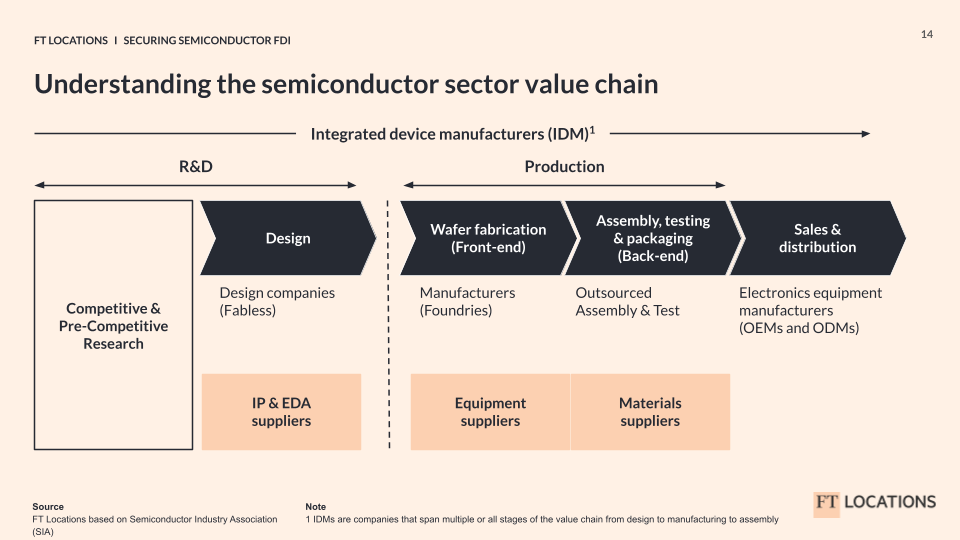
The industry spans several distinct activities, including research, chip design, wafer fabrication, assembly, testing and packaging (ATP), equipment and materials production, and downstream electronics manufacturing. Each segment has different location requirements, investment profiles and competitive dynamics.
Rather than pursuing every opportunity, locations should identify the parts of the value chain that best align with their existing strengths and capabilities.
A practical framework for attracting semiconductor investment
Here is a four-step framework for developing an effective semiconductor FDI attraction strategy for locations seeking to explore opportunities in the sector:
Step 1: Identify which value chain segments represent the strongest opportunity. This requires assessing local competitive advantages, benchmarking against comparable locations already attracting semiconductor investment, and evaluating the potential economic impact in terms of jobs, skills and technology transfer, ecosystem development and capital expenditure.
Step 2: Analyse where investment is currently flowing. Emerging markets such as Malaysia, Vietnam, Mexico, the Philippines, Brazil and Poland have all attracted different types of semiconductor projects. Understanding which locations are succeeding in specific segments provides valuable insight into realistic and contestable opportunities.
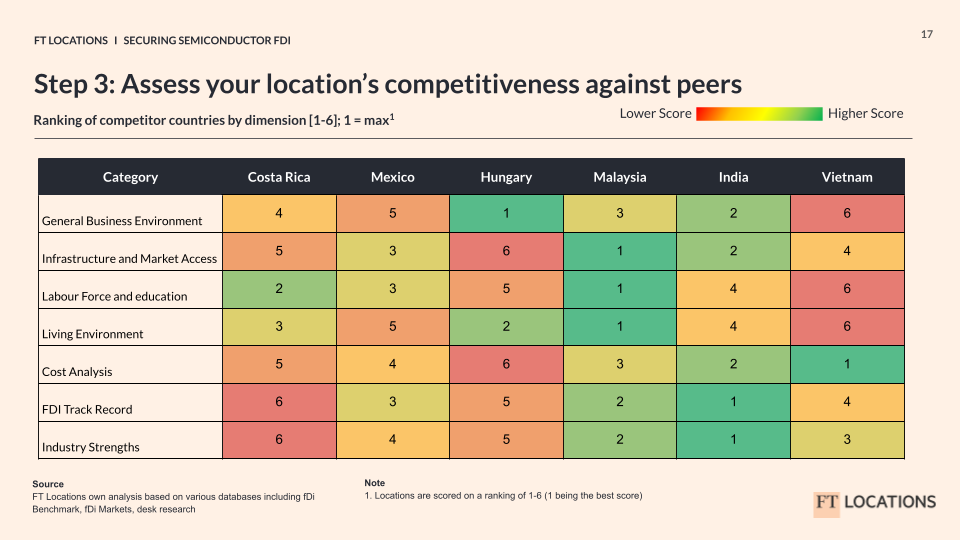
Step 3: Benchmark competitiveness. This involves comparing locations across key investment factors including business environment, infrastructure, workforce quality, operating costs, existing semiconductor presence and overall FDI track record. Honest assessment against comparable peers is essential for identifying both competitive strengths and areas requiring further development.
Step 4: Locations should prioritise target markets and develop focused business development strategies. Rather than targeting every potential investor, resources should be directed towards leading semiconductor clusters such as Taiwan, the US, Germany, the Netherlands, Singapore, Malaysia, South Korea and selected regions of China, where many of the industry's decision-makers and ecosystem leaders are concentrated.
Strategic lessons for investors and IPAs
The webinar concludes with three important strategic messages.
First, success depends on building ecosystems rather than simply attracting individual projects. Investors increasingly seek locations that complement existing global supply chains instead of attempting to replicate entire semiconductor clusters.
Second, credibility matters more than promotion. Companies need clear evidence that a location possesses the required talent, suppliers, infrastructure, research capability and execution capacity before considering major investment.
Finally, semiconductor investment is inherently long term. Predictable policy environments, sustained government commitment and continuous ecosystem development are valued more highly than short-term financial incentives alone.
Ultimately, the strongest semiconductor investment strategies begin with a realistic assessment of existing capabilities and focus on building distinctive strengths within the global semiconductor ecosystem rather than attempting to compete across every segment of the industry.
To learn more about our advisory work in the semiconductor segment, get in touch or visit our website.
Watch the full webinar on demand
Further reading
Read blog: Winning semiconductor FDI: The PITCH framework for investor-ready location propositions
Read blog: Brazil between blocs: Do economic alliances drive investment?
Read blog: Energy transition hit by fossil fuel investment surge
Unlock your location's investment potential with fDi Strategies
Turn global investment data into trusted insight with fDi Markets
Compare locations with intelligence that drives better decisions using fDi Benchmark
Learn more about FT Locations
FT Locations is the world's most comprehensive and trusted provider of investment promotion and economic development data and digital solutions for the foreign and domestic direct investment industry.

