
Thought leadership
Why intelligent investment promotion still starts with humans
AI is reshaping how investment promotion agencies engage investors, but it carries risk when used as a substitute for strategy or lead generation. The agencies seeing real impact use AI to strengthen intelligence, sharpen positioning and support human decision-making, not to replace it. In investment attraction, success still starts with people.
- January 20, 2026
-
By Lauren Farrall

AI tools are reshaping how IPAs market to investors, but impact depends on how they’re used
The AI tools gap in investment promotion
Artificial intelligence (AI) tools are being adopted quickly by investment promotion agencies (IPAs) and economic development organisations (EDOs), from investor chatbots to content generation and data & analytics. In many cases, AI performs best where it removes friction: helping investors find relevant information faster, supporting early-stage enquiries, and improving internal consistency.
Invest Qatar’s AI-powered investor assistant, Ai.SHA, is a good example. Designed to help investors navigate business setup and incentives, it clearly signposts the limits of automation and the continued role of human support. Similarly, CINDE’s use of AI for predictive analytics and investor profiling has been part of a multi-year trial and implementation programme since 2023. Reportedly, its model draws on 150+ data points across 800,000 firms to help identify potential investment prospects.
These initiatives demonstrate how AI can enhance operational capability. But they also highlight a growing gap between what AI promises and what it can realistically deliver in FDI contexts.
Agencies frequently report fuller pipelines, but there is still no clear evidence of materially higher win rates. Human teams continue to spend significant time qualifying and disqualifying AI-generated prospects, with little reduction in workload at later stages of the investment journey.
Key takeaways
- AI improves execution, not positioning.
- Performance depends more on strategy than on tools alone.
The structural limits of AI-led FDI prospecting
AI-led prospecting can look sophisticated on paper. In practice, its limits are structural rather than technical.
1. Models can’t capture human intent or emotion
AI systems are model-based by design. They can identify likelihood from data patterns, but they cannot capture the human factors that often trigger major investment decisions, including; confidence in leadership, personal risk appetite, geopolitical considerations and informal signals exchanged in conversation. Investment decisions are frequently shaped by trust and timing, built through meetings, site visits or industry events. No AI model can replace that.
2. Data lag and blind spots
Most AI models rely on historic, public or third-party data, including: financials, patents, hiring patterns, and news signals. This data can lag reality by 6–18 months. Confidential triggers such as M&A planning, geopolitical hedging or supply-chain disruption, often very decisive in FDI, are not considered by AI algorithms.
3. Volume over value
AI increases the quantity of leads, not necessarily conversion quality. Pipelines grow, but outcomes do not improve proportionally. The burden of filtering still falls on human teams.
4. Over-standardisation of outreach
AI-driven targeting frequently produces homogenised messaging. Senior executives quickly recognise templated or data-led outreach that lacks sector nuance, strategic empathy or timing, undermining credibility at C-suite level.
5. Hard-to-prove ROI in FDI terms
FDI outcomes are long-cycle, low-volume and politically contextual. AI performance is difficult to link directly to jobs, capex or location wins, making it a support tool rather than a defensible decision engine.
Why strategy still determines AI impact
AI outcomes in investment attraction are shaped long before any tool is deployed. Agencies with a clear view of priority sectors, target investors and value propositions are able to use AI to scale what already works.
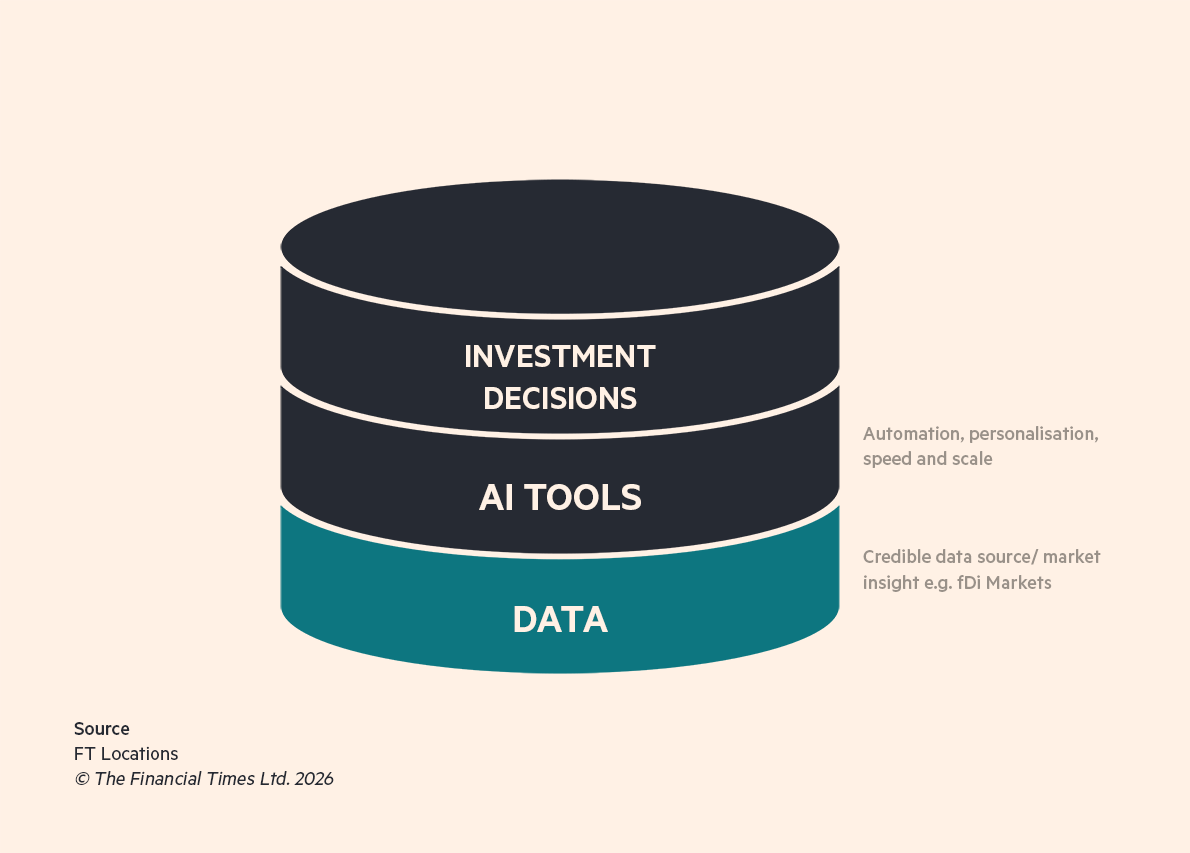
AI tools are only as good as the intelligence beneath them
In this context, AI supports research, content adaptation and enquiry handling, while humans retain responsibility for judgement, nuance and investor relationships. This is reflected in how Invest Hong Kong has applied AI to support campaign development, using it to enhance creative execution, while keeping narrative control and positioning firmly human-led.
Without that strategic foundation, AI-generated outputs quickly become generic and harder to trust.
Key takeaways
- AI amplifies existing strengths and weaknesses.
- Human judgement remains central to investment decisions.
Credibility, trust and data risk
Investment promotion operates in a high-trust environment, often involving sensitive information about investors, projects and incentives. AI expands capability, but also increases exposure to misinformation, impersonation and data leakage.
Investor-facing AI must be accurate, current and transparent about its limits, with clear routes to human support. Several agencies, including Invest Qatar, now explicitly warn users against entering personal or sensitive data into AI tools — protecting trust by setting expectations early.
Public-sector experience shows how quickly trust can be lost when AI is misapplied:
- UK A-level grading algorithm (2020): An automated model downgraded nearly 40% of student grades, triggering public backlash and a full reversal.
- Netherlands childcare benefits scandal: AI-driven fraud detection wrongly accused thousands of families, leading to government resignations and long-term institutional damage.
- US unemployment insurance systems: Automated fraud detection falsely flagged legitimate claims during COVID, delaying payments and prompting legal challenges.
Wider research shows that a large share of AI projects in both public and private sectors never reach production or deliver measurable ROI, leading Gartner to predict 30% of generative AI projects to be abandoned by the end of 2025. According to analysts, a significant proportion of generative AI initiatives are abandoned after proof-of-concept due to unclear business value, data and governance challenges, and rising costs.
Key takeaways
- Trust is a competitive advantage in investment promotion.
- Transparency and governance are non-negotiable.
From AI tools to investment intelligence
The agencies moving ahead are those integrating AI into a broader intelligence-led approach. Rather than focusing on output, they prioritise insight, using AI to surface relevant data, support evidence-based storytelling and connect investors to the right opportunities.
Invest Estonia has applied AI across research and investor targeting in this way, augmenting internal capability rather than automating decision-making. The objective is not to replace expertise, but to strengthen it.
AI will continue to reshape investment marketing. The differentiator will not be who adopts the most tools, but who uses them to support intelligent, credible and strategic decision-making, while recognising that investment decisions remain human at their core.

Data can inform decisions, but it cannot replace human judgement, emotion, and intent
Trust, confidence and intent are shaped through relationships, dialogue and experience, not algorithms. Used well, AI streamlines long and repeatable processes where the risk of error is limited, freeing investment promotion teams to focus their time where it matters most: meaningful engagement with investors.
Where AI predicts patterns, fDi Markets reveals the driving motives behind investment decisions. While AI can be used to enhance productivity and trends, fDi Markets captures real, announced and in-progress investment decisions, validated by journalists, researchers and company disclosures.
This is where FT Locations products and services play a pivotal role, combining trusted data, market insight and decision-support tools that help IPAs and EDOs turn activity into informed action.
Key takeaways
- AI cannot capture the human emotion and intent that drive investment decisions.
- AI delivers value when paired with high-quality intelligence.
- AI is most effective when applied to repeatable, low-risk processes — freeing teams to focus on investor relationships.
- Better decisions drive better investment outcomes.
Further reading
Invest Qatar — Launch of Ai.SHA, an AI-powered investor assistant
Invest Hong Kong — Using AI in investment promotion campaigns
Invest Estonia — How AI is used in investment promotion
CINDE’s use of AI for predictive analytics and investor profiling
Learn more about FT Locations
FT Locations is the world's most comprehensive and trusted provider of investment promotion and economic development data and digital solutions for the foreign and domestic direct investment industry.

