
Thought leadership
How IPAs can embrace AI and maintain investor trust
Artificial intelligence (AI) offers investment promotion agencies (IPAs), particularly those with limited resources, opportunities to streamline workflows, improve content creation and reach new audiences. However, as AI becomes increasingly integrated into place branding and investor engagement, IPAs must balance its benefits with the need to maintain authenticity, credibility and trust. A considered approach to AI adoption is essential to protecting a location’s reputation and brand integrity.
- October 22, 2026
-
By Jonathan Wildsmith

Artificial Intelligence (AI) has become almost unavoidable in our day-to-day lives, from LLM-powered chatbots to embedded tools that support and automate workflows. For investment promotion agencies (IPAs), particularly those operating with small teams, limited expertise and budgets, these tools have already been shown to enhance capabilities across different business areas.
In place branding, building a trusted reputation and managing the public perception of your location are key. As AI makes it easier to create investor-facing materials, could certain applications jeopardise the authenticity, credibility, distinctiveness, and integrity of your brand?
For resource-constrained IPAs, AI is potentially extremely valuable, helping to streamline content creation or even reach new audiences, with AI itself now an audience in its own right (City Nation Place, 2026). However, place branding relies on authenticity and trust. That is precisely why IPAs need a sensible approach to using AI.
AI is reshaping the capabilities of IPAs
By and large, businesses have moved on from the stance of “should we use AI?”. A monthly index by payment fintech Ramp shows that 55.7% of the surveyed companies in the 70,000 sample were AI adopters in July 2026.

The rapid trajectory of AI in the last few years has accelerated the capabilities of IPAs and EDOs the world over, albeit the disparities between advanced economies and developing economies risk widening certain inequities rather than levelling the playing field. Research by the Bank for International Settlements found that countries with stronger digital infrastructure, clearer regulatory frameworks and a more skilled workforce see larger growth effects from AI, with advanced economies tending to score higher on these dimensions. According to the World Bank Group’s World Development Report 2026: The Promise of Artificial Intelligence, developing countries risk being left behind if governments do not act swiftly to address gaps in power, connectivity, skills, and institutional quality.
When AI-generated content undermines authenticity and trust
Over the past year, the FT has reported on several professional services firms’ use of AI, which led to inaccuracies and hallucinations. When I prompted Ask FT, the FT’s AI-powered search and summarisation tool developed for professional subscribers, if using AI weakens credibility, it responded, “Much of the credibility risk stems not from AI use itself, but from the lack of disclosure”, insinuating that transparency is the real issue. At the same time, it directed me to Elaine Moore’s article, Did AI write this? It’s getting harder to tell which, amongst other things, explores what is fair use and where the line should be drawn. It also highlights that there is a stigma attached quite broadly to AI-generated content because it has been linked to low-quality outputs or “AI slop”, as it is commonly referred.
Even if you or your organisation are transparent about what content or tasks are AI-generated, you can still run the risk of undermining the outputs with your audience.
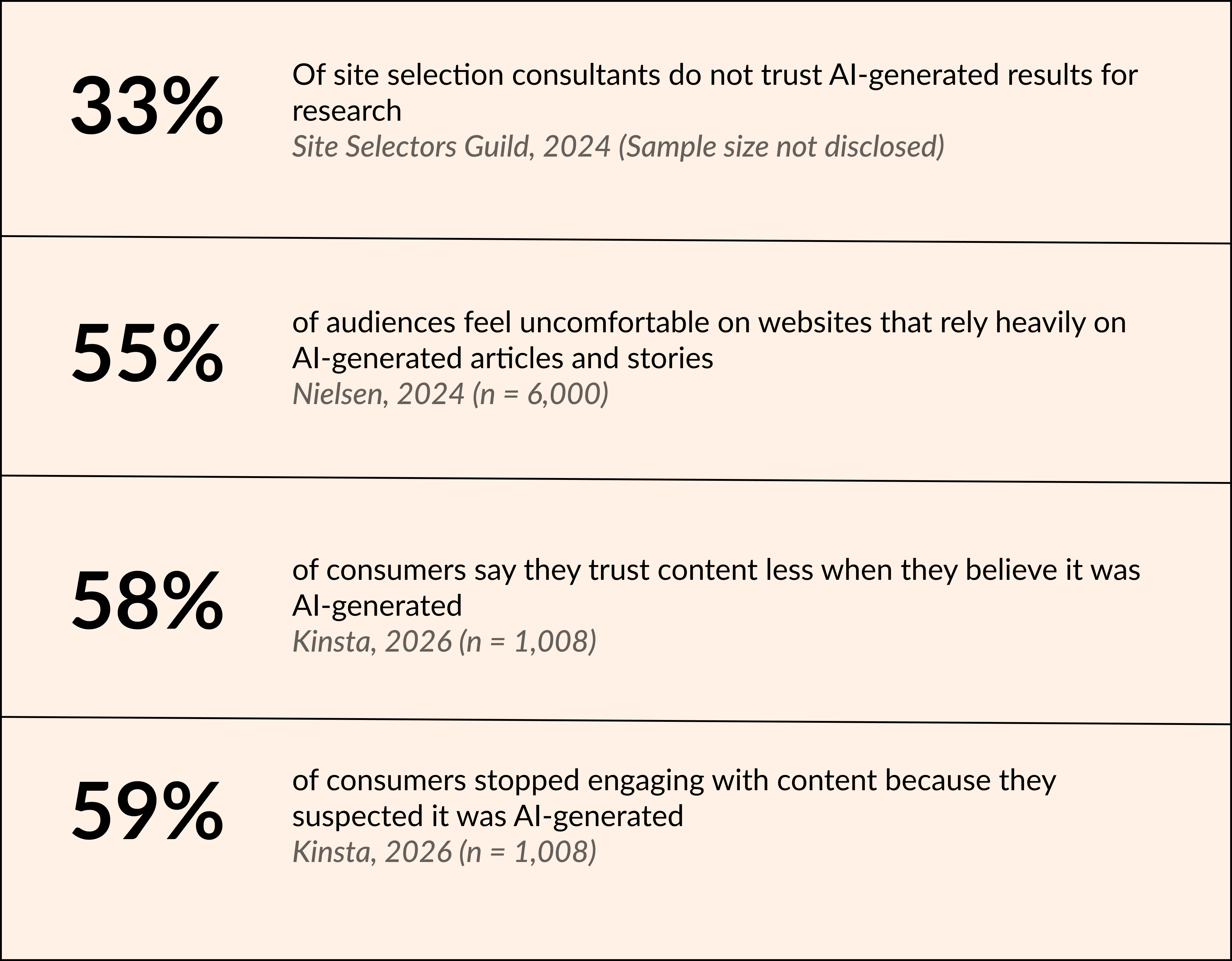
In our day-to-day lives, when using apps on our phones, you may have come across content labelled as “AI info” or “Made with AI”. If content is suspected to include AI-generated text, images or charts, are we more likely to be sceptical of its accuracy and less likely to engage with it? Now, this could all change as future iterations of AI models make it harder to determine what is human and what is AI-created and perhaps perceptions will change as well. However, if we apply this line of thinking to place branding and investment attraction, even if you are able to develop more content, post more often and create dynamic visuals with AI, will it engage your target audience, or are investors going to be turned off by it?
If an image is entirely AI-generated, even when disclosed, it risks creating expectations that cannot be substantiated, by extension, undermining credibility. Bloom Consulting warns against “Cultural homogenization”, which it describes as over-optimising for global appeal risks erasing local identity. AI should be leveraged to make your organisation and teams more capable, not make the location less recognisable. Place branding focuses on what makes a location unique, whereas AI models train on existing web data, potentially rendering your propositions as generic.
How to balance the use of AI
UNCTAD advises IPAs to follow two fundamental principles to ensure responsible AI use:
- Meaningful evaluation: Consider the risk and impact of AI tools, particularly their contribution to organisational objectives and investor needs, and adopt KPIs that measure efficiency gains, conversion rates and investor satisfaction.
- Proportional human oversight: While AI models are improving rapidly, they can still generate fabricated and incorrect information, requiring mandatory human review and verification, especially on higher-risk activities such as due diligence assessments, incentive commitments, and legal determinations.
Adopting these principles specifically to place branding, AI can assist in the execution of certain tasks, but the process must be human-led to ensure outputs are verified and do not falsely represent your location. It is more important to capture the individuality of your location, for example by capturing and sharing real photography rather than depicting AI-generated images, which can produce standardised outputs.
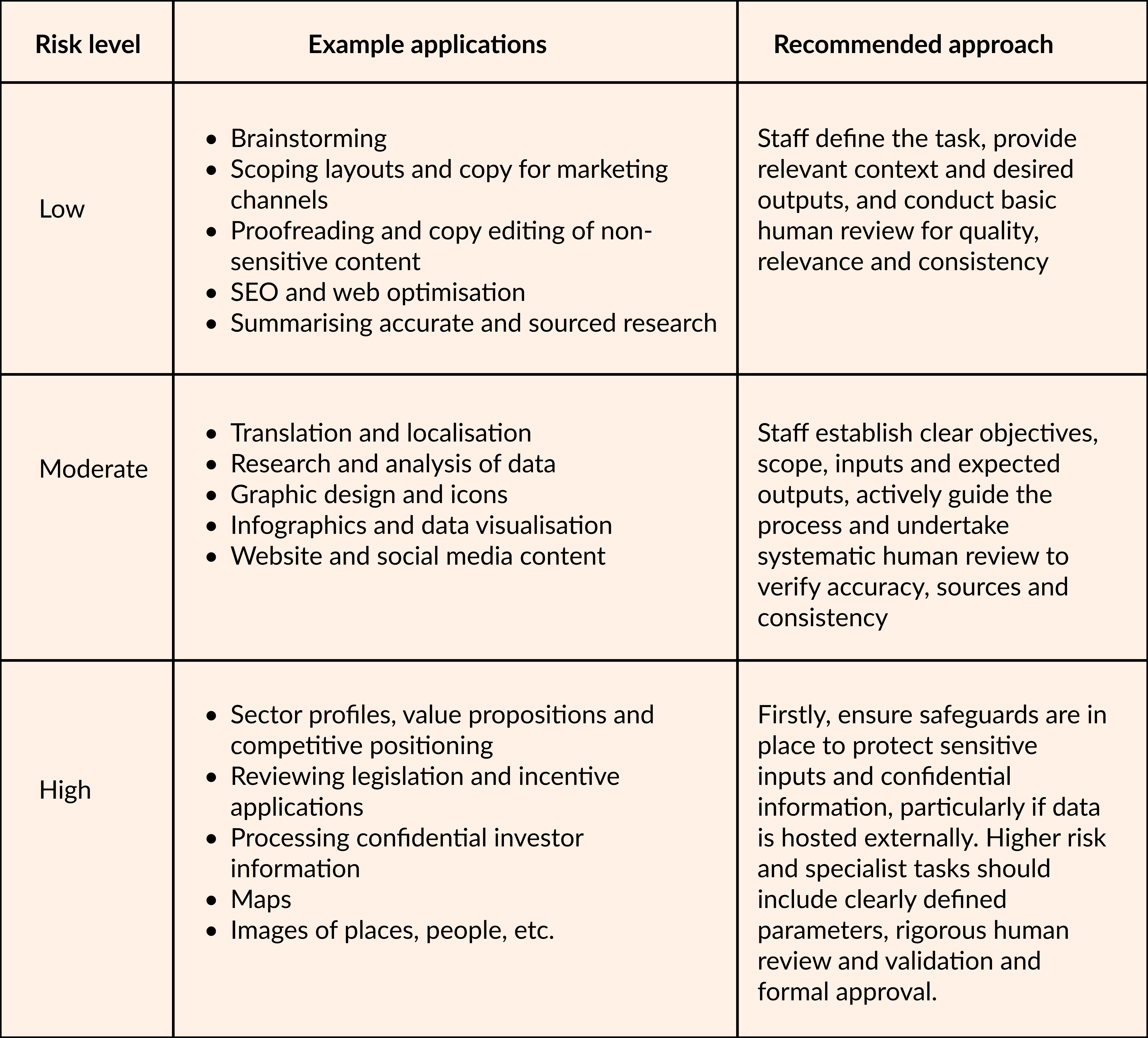
Importantly, the level of risk associated with AI does not solely stem from the type or format of content being produced, but risks largely arise from how content is used, the processes involved, the potential consequences of inaccuracies, and confidentiality considerations. For IPAs, which are expected to be trusted sources of qualitative and quantitative insights that guide the investor journey, it is essential to maintain appropriate human oversight to ensure outputs are accurate and that confidential or sensitive information about investors and projects is safeguarded.
AI applications require different levels of human oversight
Five practical steps for IPA leaders
-
Establish and embed an organisational AI use policy Introduce principles or an acceptable or responsible use policy for AI that protects your brand, intellectual property and business. This should include guidance on approved tools, applications, data protection, confidentiality, ethics, responsibilities and human oversight.
-
Invest in AI literacy and training Seek out experts and training opportunities for you and your teams to support AI adoption. fDi Institute offers tailored workshops on digital tools and AI, while fDi Intelligence supports continuous learning from industry insights and interviews. Encourage staff to experiment, within the bounds, with AI to develop their own expertise and share knowledge internally to capture the potential gains from AI.
-
Prioritise reliable data and expert analysis Ground investor-facing materials in credible data, verified sources and specialist analysis. AI tools that scrape the web rely on publicly available data and information, unable to draw upon proprietary investment intelligence with details on FDI trends, investor activity and location competitiveness, and specialist expertise that informs investment promotion strategies and the development of data-driven value propositions.
-
Prioritise authentic, real-world content Use real photography, investor testimonials, company success stories and local perspectives to showcase what makes your location distinctive. First-hand experiences and tangible examples can provide more compelling evidence than generic outputs.
-
Monitor and evaluate AI adoption Establish SMART objectives and KPIs to assess AI adoption. Gather regular feedback from staff and investors to identify what is working well and what is not, to refine the approach.
As AI becomes more widely accessible, communicating with authenticity, credibility, distinctiveness, and integrity becomes an even greater competitive advantage. AI tools offer IPAs the opportunity to bridge skills and resourcing gaps, but the value and impact of these tools can extend beyond producing quicker outputs. AI can also support learning and develop in-house expertise to support the human judgement and oversight required to build or protect an organisation’s reputation. Ultimately, place branding is built on the people, assets and characteristics that make a location unique. AI should support this story and not risk the authenticity of the story itself.
Further reading
Did AI write this? It’s getting harder to tell by Elaine Moore
Build a competitive investment strategy with fDi Strategies
Blog: Why intelligent investment promotion still starts with humans
Learn more about FT Locations
FT Locations is the world's most comprehensive and trusted provider of investment promotion and economic development data and digital solutions for the foreign and domestic direct investment industry.

